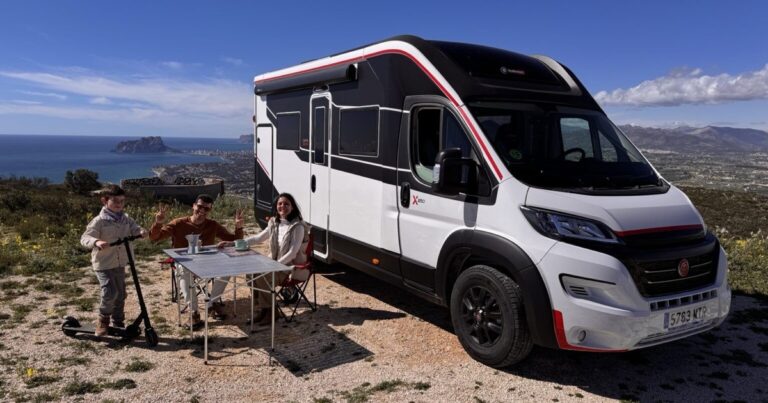
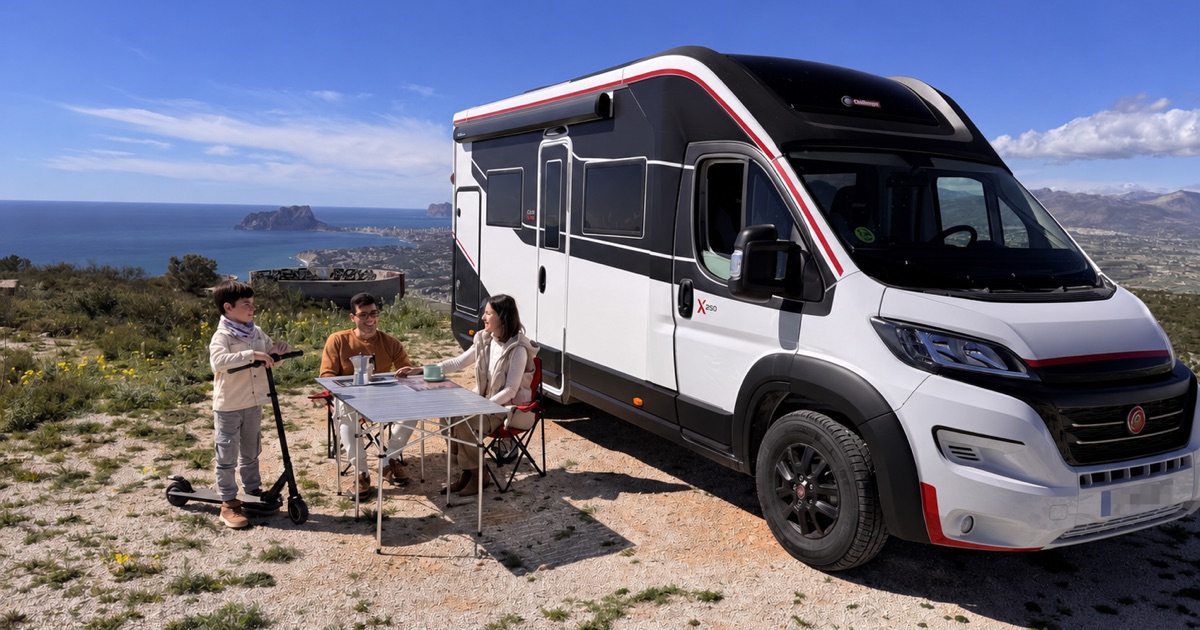
The best camper trips are not races between pins on a map. They leave time for a quiet coffee, a change of plan and the viewpoint that looks better in real life than it did on your phone.
This three-day Costa Blanca route begins in Benitachell, where you collect the Cumbres Camper Challenger X250. It moves gently through Xàbia, Moraira, Calpe and Altea before returning to the starting point. There is deliberately no promise of a particular parking space or overnight pitch: access, signage, municipal rules, weather and seasonal demand can all change. Treat the itinerary as a flexible shape for the journey, then confirm the practical details before each stop.
Why start a Costa Blanca camper route in Benitachell?
Benitachell sits between Xàbia and Moraira, so the road trip starts inside the landscape you came to explore. There is no long transfer before the coast begins. You can collect the vehicle, complete the handover properly and make the first day feel like part of the holiday rather than a drive to the holiday.
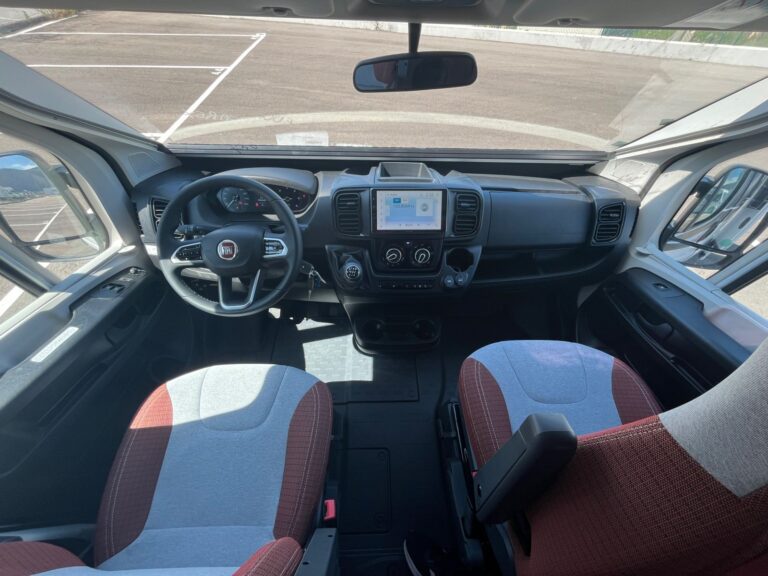
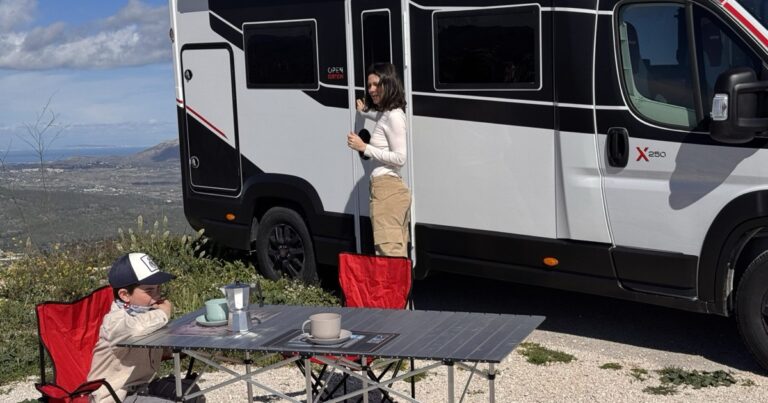
The Challenger X250 camper carries up to four people and sleeps up to four. Its on-board kitchen, fixed toilet, separate shower and adjustable storage are especially useful on a short moving route: breakfast does not depend on finding an open café, wet beach gear has somewhere to go, and the day can change without the interior becoming chaotic.
Before committing to the trip, check your dates and read the seasonal rates.
Before setting off: parking, overnight stays and seasonal access
Spanish traffic rules distinguish parking from camping. The DGT’s current motorhome guidance explains that a correctly parked motorhome remains a parked vehicle when it stays within the marked space, rests on its tyres and does not extend awnings, tables, chairs, stabilisers or other elements beyond its footprint. Discharging fluids is not permitted. These parking conditions were also incorporated into the national traffic-rule update that entered into force on 1 October 2026. Municipalities may still regulate where and for how long motorhomes can park, and local signs must be respected. The DGT’s 2026 motorhome instruction and summary are the right starting point, but they do not replace a town’s current rules.
For this route:
- choose a campsite or authorised motorhome area for each night before departure;
- confirm its current access conditions, arrival arrangements and availability directly;
- check municipal notices and the signs on arrival rather than relying on an old app review;
- do not assume that a scenic car park permits an overnight stay;
- keep the vehicle closed within its footprint whenever it is parked on a public road;
- avoid forcing a large vehicle into a narrow historic centre or crowded cove access.
In summer and during public holidays, build in extra flexibility. Coastal access and traffic arrangements can change to manage demand. Xàbia’s official visitor information, for example, notes seasonal vehicle controls at Granadella. That makes a viewpoint, town walk or less pressured beach a better plan than treating one famous cove as non-negotiable.
Day 1: Benitachell and Xàbia, one viewpoint at a time
Start with the handover, not the itinerary
Give the collection enough time. Learn where the controls, water system, kitchen equipment and storage are before setting off. Adjust the mirrors, agree how luggage will be stored and make sure every traveller understands that the living area must be secured for driving.
The first useful decision is also the simplest: do not try to “complete” Xàbia in an afternoon.
Choose one face of Xàbia
Xàbia offers three very different moods: the old centre around the fortress church of Sant Bartomeu, the port, and a long coastline of beaches, coves and viewpoints. The official destination guide describes a route linking 15 coastal viewpoints from Cap de Sant Antoni towards the southern coast. It can be explored in sections rather than as a single challenge. See the official Xàbia destination guide and the local tourism office’s English visitor guide before choosing your stop.
For a slow first day, pick one of these approaches:
- park legally outside the tightest streets and walk through the old centre;
- spend time around the port and La Grava waterfront;
- choose one accessible viewpoint, then continue only if the road, signs and legal parking suit the vehicle.
Do not drive the whole viewpoint route simply because it exists. A motorhome changes what counts as an easy access road. If a turn feels too narrow or a car park too constrained, continue to a safer alternative.
The local service page for camper hire near Jávea is useful if Xàbia is the main reason for your trip.
End the day without chasing a sunset pitch
Leave the coast with enough daylight to reach the campsite or authorised area you confirmed earlier. A legal, calm overnight stop is worth more than a last-minute view. Once parked under the site’s rules, the X250’s kitchen and lounge make it easy to slow down: cook, look at the next day’s weather and decide how much of the plan still feels right.
Day 2: Moraira, the Benissa coast and Calpe
Morning in Moraira
Moraira works well as a morning stop because the town’s character is easy to appreciate on foot: a traditional harbour, the waterfront and the compact castle beside L’Ampolla beach. The Valencian Community’s official tourism portal explains that the 18th-century Moraira Castle was built as part of the coast’s defence and now contains an interpretation space devoted to the sea and piracy.
Again, the aim is not to take the vehicle to the landmark. Follow current signs, choose a legal space that genuinely fits, and walk the final section. If you want more context before travelling, see the page for camper hire near Moraira.
Let the Benissa coast be optional
Between Moraira and Calpe, the Benissa coastline can add a coastal walk or a pause by the sea. It should be a bonus, not a commitment. Benissa's municipal tourism portal describes the ecological coastal walk and its section towards Les Bassetes in the official Benissa ecological walk guide.
If access is busy, parking is unsuitable or the weather has turned, continue. A three-day route becomes more enjoyable the moment you stop trying to win every stop.
Choose one Calpe experience
Calpe can easily fill a day, so choose according to energy and season:
- walk through the old town and see the Torreó de la Peça and remnants of the former walls;
- take a gentle waterfront walk with the Peñón de Ifach as the backdrop;
- visit the natural park only after checking the current access requirements.
Calpe’s official tourism site says advance booking is mandatory for visiting the Peñón de Ifach and describes the route beyond the tunnel as the more demanding section. Check the current instructions on the official Peñón de Ifach page rather than building the day around an assumed entry. The official cultural guide is a good alternative when hiking does not suit the conditions.
Finish at the second pre-arranged campsite or authorised motorhome area. Use the evening to reset the interior, charge devices and confirm the next day’s conditions.
Day 3: Altea and the unhurried return
Walk into Altea’s old town
Altea rewards a slow walk more than a long list. Its historic centre climbs towards the church square, with surviving gates and the original street pattern of the fortified enclosure. The official Altea tourist guide highlights Portal Vell, Portal Nou and the Plaza de la Iglesia viewpoint as part of that historic layout.
Choose legal parking before entering the most compact streets and continue on foot. The climb is part of the visit. Allow time to look back towards the coast instead of arriving, taking one photograph and immediately leaving.
Return with time in hand
The last leg should include enough margin for the practical end of a rental: fuel or other agreed return conditions, personal belongings, waste handled only at authorised facilities, and an unhurried handover in Benitachell. Check the rental agreement rather than assuming what the vehicle must contain or how tanks should be returned.
If the weather, traffic or energy level changes, Altea can be shortened or left for another trip. A successful route is not the one that preserves every line of the original plan. It is the one that remains safe, legal and enjoyable when reality intervenes.
How the Challenger X250 fits this route
This itinerary suits the X250 because it makes short transitions feel simple:
- four homologated travel seats and sleeping space for up to four;
- an on-board kitchen for early starts and flexible meals;
- a fixed toilet and separate shower;
- adjustable storage for clothing and travel equipment;
- a lounge that works for breakfast, route planning and quiet evenings;
- direct support from Cumbres Camper in English and Spanish.
It is still a motorhome, not a small car. Allow for its height, width and turning space. Pay attention to access signs and never assume that a road suitable for a car is comfortable for the X250.
What to pack for three days
Keep the list compact:
- driving licences and the documents agreed for the rental;
- comfortable shoes for old-town streets and viewpoints;
- a light layer and a waterproof layer, even when the forecast looks settled;
- reusable water bottles and a small day bag;
- chargers and a power bank;
- soft luggage that fits the storage more easily than rigid cases;
- any personal medicines and sun protection;
- a shortlist of official tourism pages and confirmed overnight contacts saved offline.
Ask what is already included before packing kitchenware or bedding. The camper hire FAQs answer the common questions, and you can ask Javier or Ana about anything specific to your group.
Extend the trip: Dénia or Guadalest
With an extra day, go in one direction rather than adding both.
Dénia keeps the trip in the Marina Alta and adds a different port and historic centre. Guadalest turns inland and changes the landscape completely. The Valencian Community tourism portal suggests both the surrounding Marina Alta and an itinerary linking Xàbia with El Castell de Guadalest, but the extra stop should have its own legal parking and overnight plan. Do not bolt it onto the third day simply to collect another place name.
For a wider menu before deciding, compare six places to visit by camper from Benitachell. That article is a destination shortlist; this page remains the complete three-day sequence.
Frequently asked questions
Can I park or stay overnight anywhere on this Costa Blanca route?
No. Parking and camping are different, and municipal rules, signs, time limits and authorised uses vary. Confirm a campsite or authorised motorhome area for each night. On public roads, follow current DGT requirements and all local restrictions.
Is this route suitable in summer?
It can be, but the plan needs more flexibility. Coastal access, traffic controls and demand for legal overnight accommodation can change in peak periods. Book the overnight stops, check municipal and tourism notices and keep an alternative for each day.
How many people can travel in the Challenger X250?
The Cumbres Camper Challenger X250 has four homologated travel seats and sleeping space for up to four people. The most comfortable setup still depends on the group’s luggage and preferences.
Do I need to hike to enjoy the itinerary?
No. The route can focus on old towns, waterfront walks and accessible viewpoints. Any trail, natural-park visit or steep old-town walk should be chosen according to current access, weather and the abilities of the group.
Can Cumbres Camper reserve an overnight pitch for me?
Ask Cumbres Camper what practical help is available, but treat accommodation as a separate booking until it is explicitly confirmed by the campsite or authorised area.
Ready to turn the route into your trip?
Check availability for the Challenger X250 and tell us roughly when you want to travel, how many people are coming and which part of the Costa Blanca interests you most.
Share the road